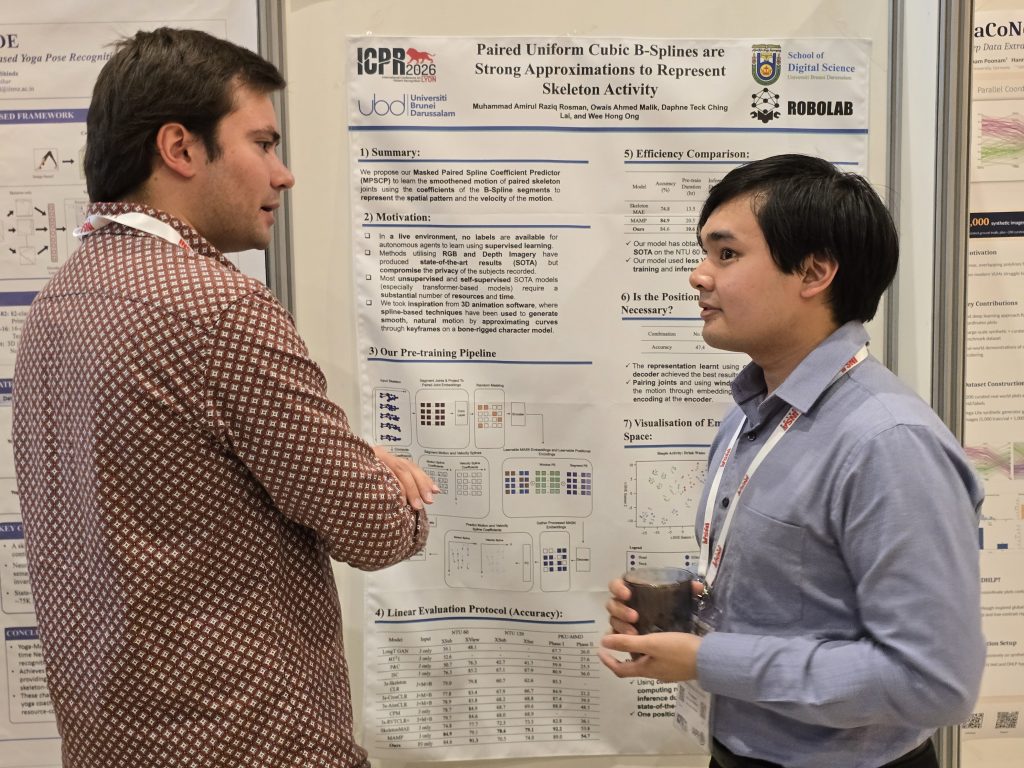
Raziq presented his paper at the poster session of the 28th International Conference on Pattern Recognition (ICPR 2026), held at the International Convention Center in Lyon, France on August, 17-22, 2026. Our paper has also been recognised with the reproducibility badge for the compliance of our published source code for reproducibility.
Source code: https://github.com/ailabspace/Self-Supervised-Human-Activity-Recognition-With-B-Spline-Approximation
“Paired Uniform Cubic B-Splines Are Strong Approximations to Represent Skeleton Activity”, Muhammad Amirul Raziq Rosman, Owais Ahmed Malik, Daphne Teck Ching Lai, Wee Hong Ong
Abstract: In a real-life scenario where an agent needs to learn the patterns of a human’s daily activities, labels are not available, making it difficult to model a representation using supervised training strategies. This has fueled research in unsupervised and self-supervised strategies. However, most of these strategies require a large amount of computing power and time to learn the patterns of these activities. In this paper, we present the Masked Paired Spline Coefficient Predictor (MPSCP), a masked autoencoder that reduces the number of embeddings per activity by projecting paired skeleton joints over temporal windows, using motion and velocity B-spline coefficients as the ground truth for self-supervised learning. This reduces both the VRAM consumption and pre-training time needed to learn the latent representations of human activities. We have performed extensive experiments on NTU RGB+D 60 and 120, as well as PKU-MMD, to verify that MPSCP has indeed learnt good latent representations of the activities while increasing the efficiency of the pre-training and linear evaluation protocol task and mitigating performance loss using spline coefficients. Our model can be found at: https://github.com/ailabspace/Self-Supervised-Human-Activity-Recognition-With-B-Spline-Approximation.


The International Conference on Pattern Recognition (ICPR) is the leading event of the International Association for Pattern Recognition (IAPR). IAPR was established in 1978, and they were celebrating (or beginning the celebration) of its 50th anniversary at ICPR 2026. ICPR 2026 was a significantly smaller event in comparison with CVPR and ICML. The conference has accepted 710 papers. It probably had around a thousand in-person attendees. It was easier to navigate the different activities including browsing the poster sessions. The main conference was held at the Lyon International Convention Center (Cité Internationale – Centre de Congrès) during the first four days (17-20 Aug), while the workshops and tutorials were held at Louis Néel Building in the Institut National des Sciences Appliquées (INSA, “Lyon National Institute for Applied Sciences”).


