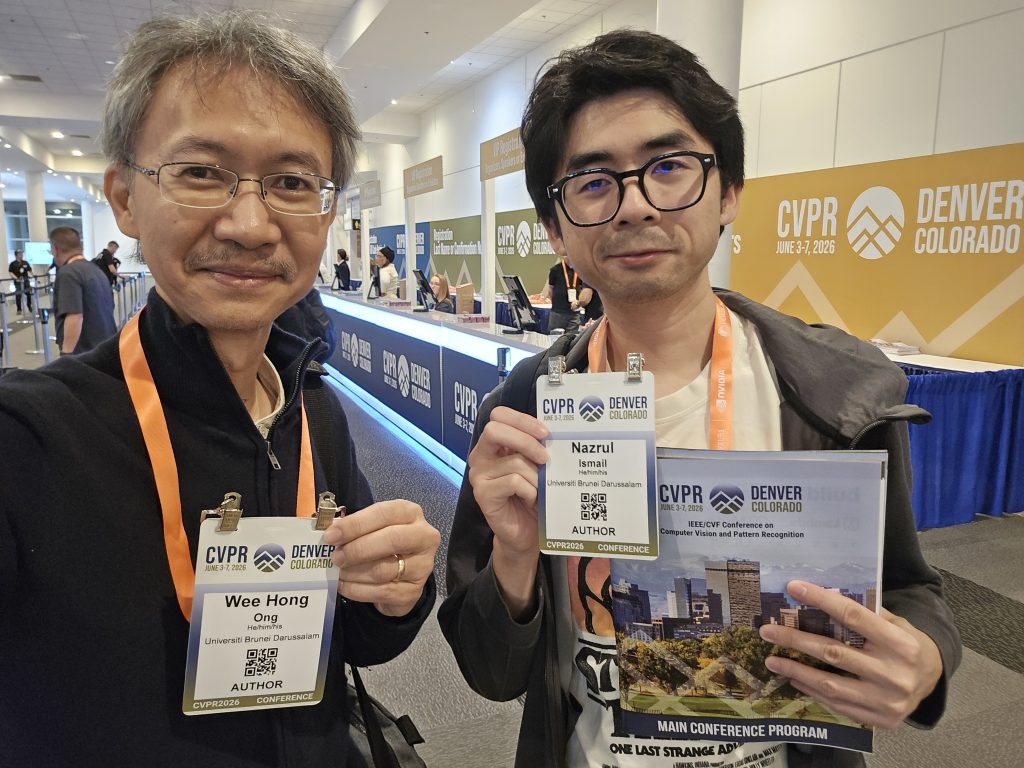
We are delighted to share that Nazrul’s paper on “Visual2Echo Compositional Contrastive Learning (V2E-CCL): Binaural Knowledge distilled network for Depth prediction” has been accepted to the Findings track in the 43th IEEE/CVF Conference on Computer Vision and Pattern Recognition (CVPR) 2026. The conference was held at the Colorado Convention Center, Denver, Colorado, USA between 3-7 June 2026.
Depth estimation from audio is a challenging problem due to the obscured nature of the depth information within the audio signals. Recent works has addressed audio depth estimation by augmenting other modalities or applying cross-modal knowledge distillation from vision to audio. Unfortunately, these approaches assume a direct transfer between modalities and heavy reliance on the vision teacher that produces erroneous output as supervisory signals. In this paper, we propose Visual2Echo Compositional Contrastive Learning (V2E-CCL), a knowledge distillation framework that bridges the visual-auditory domain gap through two key objectives: a Compositional Embedding (CE) module that refines vision teacher latent features, and a Compositional Contrastive Learning (CCL) module that aligns cross-modal spatial representations. We show extensive evaluation of our model achieves RMSE improvements of 28% on Replica dataset and 47% on Matterport3D dataset compared to prior audio-only approaches.


CVPR is widely recognized as one of the premier international conferences in computer vision and artificial intelligence. This year, the conference received ~16k submissions (excluding withdrawn and desk-rejected), with only ~4k accepted (~25%) to its main track and ~1.7k accepted to its Findings track. The conference reported 10k+ in-person attendees. Leading technology companies, including Google, Amazon, NVIDIA, Alibaba, Tesla, and Meta, as well as researchers from top universities globally, were well represented. Beyond showcasing cutting-edge research, many companies actively recruited talent and demonstrated their latest products, technologies, and services. It is a huge event with a lot of opportunities.


One fun thing we did at CVPR 2026 was the Tesla Cybertruck test ride. The glass roof is really nice. The Tesla Cybertruck operates at SAE Level 2 automation, which means it can assist with steering and acceleration under certain conditions, but the driver must remain attentive and ready to take control at all times. This level of autonomy is part of Tesla’s Autopilot system, which is designed to provide driver assistance rather than fully replace human drivers.
.
We are thankful to the Universiti Brunei Darussalam (UBD) and the School of Digital Science (SDS) for their generous financial support. We are grateful to UBD’s global engagement office for supporting Nazrul’s travel to the conference. Such support is invaluable in enabling our researchers to participate in leading international conferences and share their work with the global research community.